
Adapting, not Retreating:
How Swedish Companies are Navigating U.S. Tariffs
June 2026

BACKGROUND
The U.S. is one of Sweden's largest trade partners in both goods and services, accounting for a significant share of international business for Swedish companies. Recent shifts in tariffs, export controls, and industrial policy are reshaping the conditions for doing business in the U.S.
In line with our mission to promote trade, investment, and knowledge exchange between Sweden and the United States, SACCNY conducted a study to understand the real impact on companies operating in the U.S. market. As a connector of the Swedish-American business community, SACCNY is uniquely positioned to capture these perspectives and contribute to a stronger transatlantic business relationship.
The study captures survey input complemented by in-depth executive interviews from 43 Swedish companies, spanning SMEs to large corporations estimated to represent USD 138 billion in annual revenue combined. SACCNY collaborated with PwC US on this study, jointly designing the survey and interview framework, with SACCNY conducting the fieldwork and PwC US leading the analysis.
Explore the full report

KEY TAKEAWAYS
Companies can no longer afford to be passive. In an uncertain environment, it's easy to delay decisions — but that risks missing business opportunities and falling behind on technological development.

LEARNINGS
Uncertainty is the real problem — not the tariffs themselves
37% of respondents say it is still too early to assess profit impact in 2025, making it the most common single answer.
Companies can absorb a higher duty rate. What they cannot model is whether that rate holds next quarter — and that uncertainty has carried into 2026 with open questions around tariff refunds and how price increases already passed on to customers will play out.

LEARNINGS
Swedish companies are staying in the U.S. — and doubling down
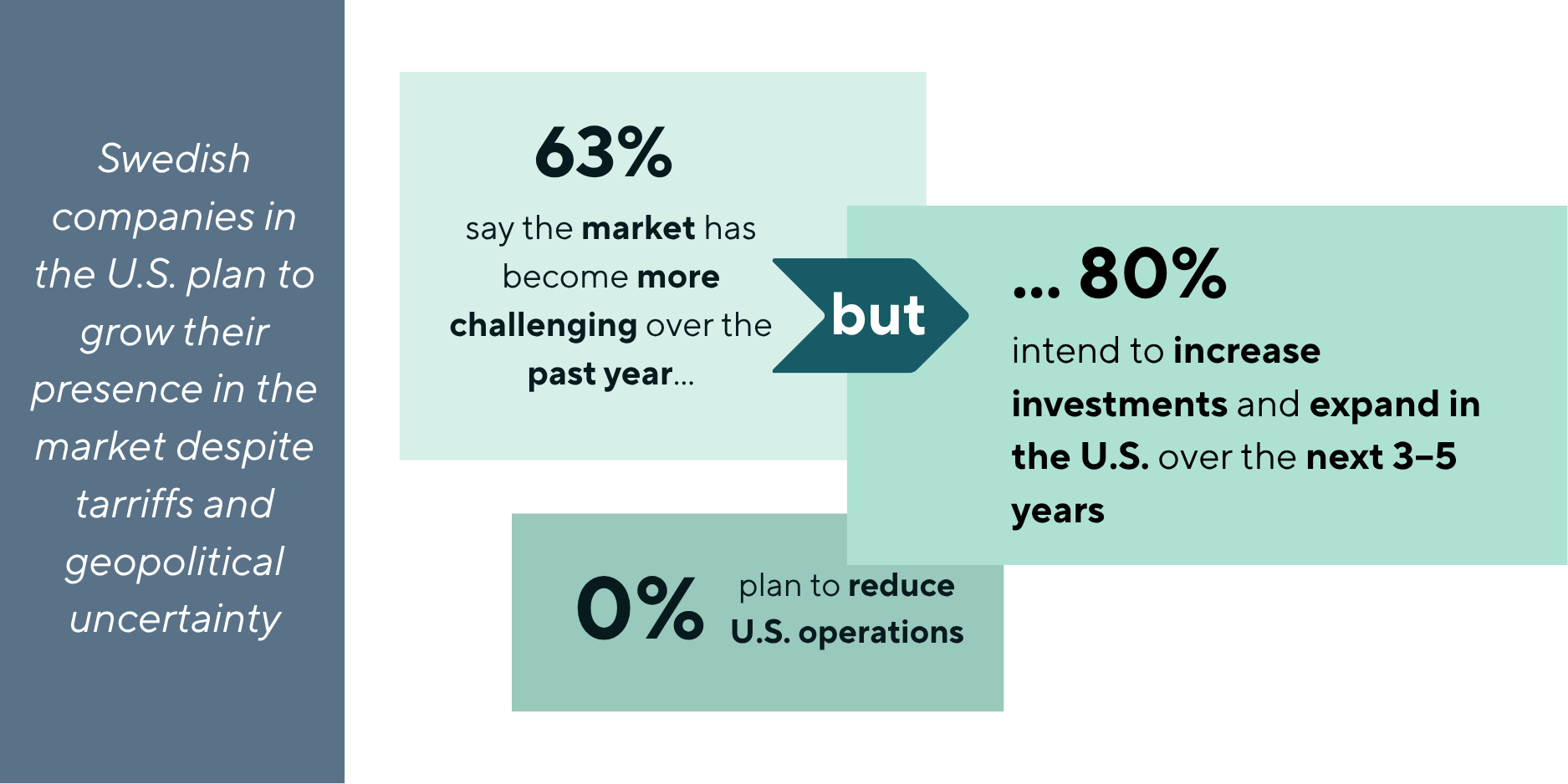
Despite 63% of respondents saying the market has gotten more challenging over the past twelve months, not a single company plans to reduce its U.S. presence over the next three to five years.
80% plan to expand. The U.S. represents the largest share of revenues for several companies in the sample, and that scale makes withdrawal a bigger risk than operating through the turbulence.

LEARNINGS
Supply chain restructuring has a customs compliance cost that most companies are not tracking
When companies shift sourcing, restructure intercompany flows, or stand up new production footprints, what gets declared at the U.S. border changes too.
CBP audit recoveries jumped from $0.7 billion in FY2024 to $34.4 billion in FY2025 — and enforcement is now being treated as a fraud matter, not a paperwork issue. The survey found nearly half of importers have a gap between what they report internally and what they declare at the border. That is an exposure most companies moving fast on supply chain strategy are not accounting for.